

The following is an edited transcript of the Journal Club with Pearls & Marketing (JCPM) of October 20, 2026, with Charles Runels, MD.
>-> The PDF transcript of this live journal club can be seen here <-<
Topics Covered
- Welcome From Romania
- PRP Injected Into the Vocal Cords
- The Vagus Nerve, Macrophages, and Botulinum Toxin
- A Year in Review: How Far We’ve Come
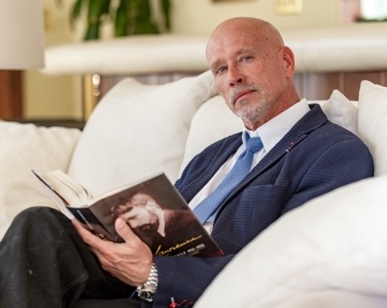
Charles Runels, MD
Author, researcher, and inventor of the Vampire Facelift®, Orchid Shot® (O-Shot®), Priapus Shot® (P-Shot®), Priapus Toxin®, Vampire Breast Lift®, and Vampire Wing Lift®, & Clitoxin® procedures.
Transcript
Welcome From Romania
Charles Runels, MD: I’m in Romania, and it seems like the hotel connection is great, but it doesn’t matter where I am. If I’m out of town, sometimes the hotel will be slower than my home office. So if I start to slow down on you, please just put something in the chat and I’ll repeat it, but hopefully this will go well.
It’s really a very unusual mix of papers. I’m here in Romania to speak to Alex Bader’s group, the European Society of Aesthetic Gynecology, and the Romanian version of that, headed by Dr. Ana-Maria Mihai, an MD, PhD gynecologist. It’s a smart group, and I’m going to give them a review of mostly what we’ve talked about here in the Journal Club for the past year.
And as I went back through it, I was surprised by how much stronger the evidence had become over the past year. I’ll give you that review when I get home next week. But I just couldn’t resist talking about these papers that came out today.
PRP Injected Into the Vocal Cords
Presbyphonia: The Aging Voice
This first one concerns the voice. As a man now approaching 70, I’ve noticed that my voice is not as deep as it once was. Let me pull this up. Here is just a general article about presbyphonia.1 It’s basically the aging voice, and that can be hormonal, or it can be the way the air moves through your throat.
But I thought this was interesting. Here’s the frequency of the voice in males and females at four years old [see video]. By the way, I’m getting to how, even though most of us are not ENT doctors, there’s a practical reason for looking at this paper, even if you’re doing sexual medicine or sports medicine.
So if you look, the frequency, of course, is higher in children. And then by the time you’re grown and all your hormones are there, and you’re making babies, it’s about the same for the females. It drops a little, then drops quite a bit for males, and by the time you reach 80, it evens out.
As a college kid, my voice was like a rumbling drum or something. It was just crazy. And so now, compared to then, I feel like I’m singing tenor, but most people still know I’m a male when I talk on the phone.
Injecting the Thyroarytenoid Muscle
Anyway, what does that have to do with anything? Normally, this is something that has to be taken care of either by putting fillers in the vocal cords or by doing surgery to help close the gap, and it’s hard to treat, and treatment is often unsatisfactory.
So they had the idea: let’s inject PRP. The anatomy of where they injected it was new to me, so I admit I had to look it up. I didn’t know what they were doing. But I had the chat draw us a diagram we can look at, so let me show it to you, and then you’ll see how it relates to sexual medicine [see video].
Of course, my wife says everything I look at relates to sex somehow, but actually this is pretty directly helpful in sexual medicine. So these are notes from the anatomy. I just gave it to the chat and I said, “Draw me a picture. I don’t understand what they did.” If you remember that photograph I showed you a moment ago, if you’re looking in with a scope (they had to do this through a flexible scope), you’re looking at the vocal cords.
The thyroarytenoid muscle makes up the fold of the vocal cord. So they looked in, went past the false or vestibular fold, and went into this muscle. They injected the muscle that helps your vocal cords move, and weakness there is part of the reason they think the range goes away.
Rock Singers and Vocal Range
By the way, I think the top ranges in the research were in rock and roll. One was Freddie Mercury, who sang for Queen, and the other was Robert Plant. And not just Plant; Prince also hits the high notes. His range was close, but Plant and the guy who sang for Queen actually get top billing, according to the research. If you know me, you know I’m a big fan of Prince. He hits the low notes, and he hits the high notes, so he gets almost all over the piano. And just listen to “Stairway to Heaven.”
To do that, you have to have vocal cords that are strong enough to go all the way, very, very closed, and yet go very wide and go deep, so lots of frequencies. Okay, so that’s what they did. They injected into that muscle.
What This Means for Sexual Medicine
Now, how does that relate? Of course, if you’re doing sexual medicine for women, you think immediately about all those little muscles in the pelvic floor that become not only tender but weak with age. And DeLancey, in some of the studies we looked at a couple of years ago, demonstrated attenuation of the nerves, blood vessels, and muscle fibers.2–6 In autopsy studies, it all goes away, or gets less numerous.
In males, there have been studies looking at making the ischiocavernosus or the bulbospongiosus muscle weaker (with botulinum toxin) to help treat premature ejaculation.7,8 Although the percentages look good (you can add 10% to 15% on a total five-minute session); it doesn’t really change what your wife says the next day.
I think for our group, what it tells us is that you can change function by a very specific and very meticulous injection of an individual muscle, and you can’t really get more specific than the thyroarytenoid muscle.
Hope that idea will trigger something new and wonderful in someone’s brain who is on this call.
Oops, I’m sorry, I was showing you the wrong thing…. I hate when I do that. Here’s what I was trying to show you, this right here. This was the diagram. It’s talking about injecting into that muscle right there, just into the vocal cord. Very, very specific [see video].
When I saw that, I thought, “Wow, if they can run a scope up through someone’s nose and down to inject into the vocal cords, what possibilities does that open when it comes to helping out with female sexual function?”
We talked about this last week. With just a little bit of study of the anatomy, you can learn to discern the various muscles of the pelvic floor and the surrounding vagina. We were talking about vaginal massage for dyspareunia a week or two ago, and how those muscles can be found and addressed individually.9
Well, they could also be attended to with injections. Maybe you don’t wait until there is pain. Maybe there could be some specific injections based upon strategies that have to do with sex.
The G-Spot Support Muscles
One thing that occurred to me years ago, when we first got our Emsella machine, was to look at the muscles that actually… Well, let’s just think about this for a second. Think about the vagina in general. Let me draw something here for you [see video]. This could be a useful idea for someone to research, I think.
So this is the urethra, here’s the anterior vaginal wall, and then here’s the anus, and here’s the buttocks, and there’s the pubis, and there you go. So there’s one side. And so this is the anterior vaginal wall, and you have the labia minora coming up like that, and you have the clitoral hood and the frenulum on both sides. That would be the clitoris I drew there, so this would be the urethra right there.
Now, consider where most of the sensation with sex is. Those of you who’ve done it for a while have probably discovered that you can inject the anterior vaginal wall with no numbing cream at all. When my wife Alex does it, she doesn’t use numbing cream. I put some there just because it’s good therapy for me, but the patients don’t really need it. So sensation with sex is not about surface perception of much of anything within the vagina: maybe heat or cold, maybe vibration. But for touch, there’s not much there, unlike the clitoris, of course.
I’m telling you things that you know already, but just so we can have it for conversation: the corpus cavernosum runs down along the pubic rami, and you have the spongiosum here, and you have the urethra. Remember, that’s what Dr. Gräfenberg said was the most erotic part of a woman’s body: what you’re pressing when you find the G-spot.10 So all of the fun is up front.
So now, just for a thought experiment, imagine a vagina with no posterior wall at all. You could have a King Kong penis, and still there would be almost no pressure against the anterior vaginal wall, because there would be nothing posteriorly to hold it in place. So you can look at the anatomy and actually figure out which muscles of the vagina and pelvic floor contribute most to this anterior push from the posterior part of the vagina, so that no matter the size of the penis, there might be more stimulation of the anterior wall.
So when I first got my Emsella, I thought, “Well, how could you make that happen?”
And one way you can more specifically target what I call the G-spot support muscles, or GSM, which is a name I came up with… Holy smoke. Am I doing it again? Are y’all not seeing this? Why do I keep doing that?
Okay. So here [see video]. You have the urethra, the anterior vaginal wall, the clitoris. If there’s nothing back here, a penis of any size is not going to press. So you need something back here. My point is that you can think of ways to maybe make this stronger without really changing the overall circumference, say, of the vagina.
One way is, if you have your Emsella, have the woman lean forward. That targets the muscles pulling the posterior vaginal wall forward, increasing pressure here [see video]. Again, if there were no posterior wall, there’d be no pressure, no matter what the relative size of the female and male genitalia.
Ideas for Research
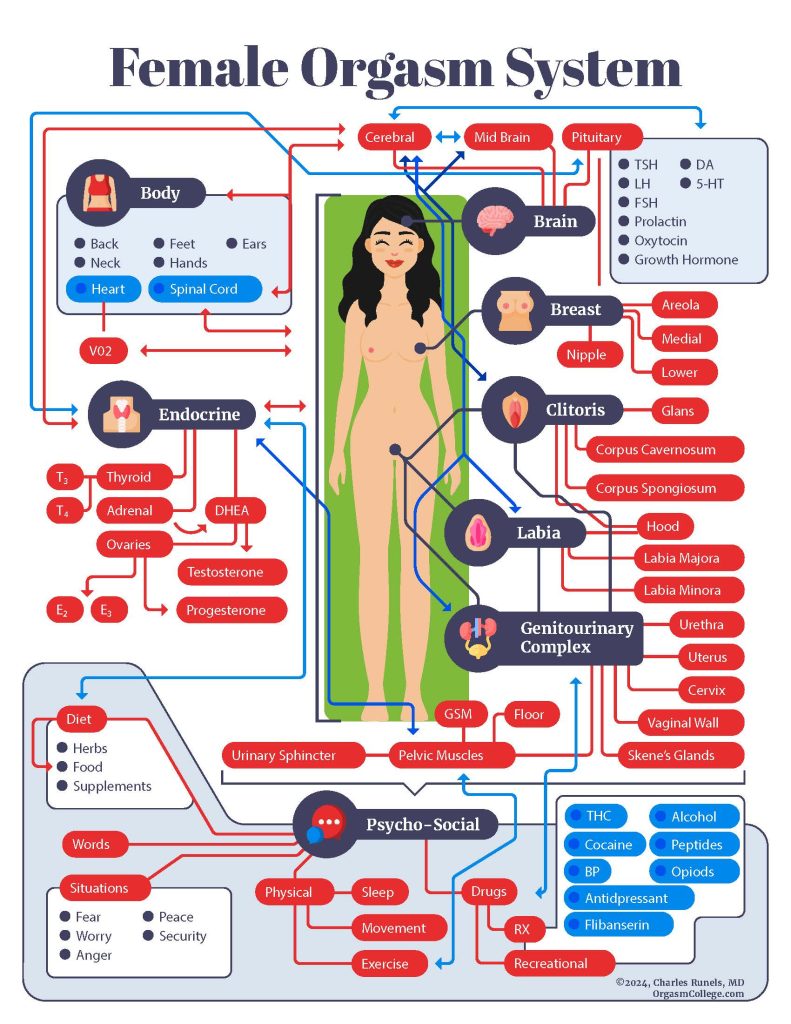
All that to say, it could be that, with thought, some of these individual muscles might be injected, just like they did in this study, to try to create more sensation. Because if you can inject this tiny little thyroarytenoid muscle, perhaps you could inject the ischiocavernosus muscle and a couple of others that I think are mostly responsible, and I explain that in our Female Orgasm System course.
Okay. So that’s all I’ll say about that one. I wouldn’t spend too much time on it. Again, that was about presbyphonia, but it helps me think about how we could use it in male and female sexual dysfunction.
The Vagus Nerve, Macrophages, and Botulinum Toxin
An Idea Worth Testing
Let me change what you can see so I don’t forget it again. This next one is even further out there, and even more unusual. The author admits that it’s an idea. In other words, he hasn’t done a study to prove it, and I think this could just as well have been published in Medical Hypotheses, one of my favorite journals. But what caught my attention was that he talks about the vagus nerve–macrophage connection and botulinum toxin.
The Cholinergic Anti-Inflammatory Pathway
So the idea is that there’s a circuit I wasn’t aware of: the vagus nerve mediates an anti-inflammatory reflex, the cholinergic anti-inflammatory pathway. If I was ever taught that, I forgot it.
Here’s the way I like to keep it straight: if you think of the brain as the center of it all, afferent arrives at the brain, and efferent exits the brain. So the efferent vagal arm of the inflammatory reflex, leaving the brain, behaves as a rheostat for the musculoskeletal microenvironment.
I’ll put this in the chat box before I close it down, but he makes a strong argument that, because orthobiologics such as PRP act within this milieu, cholinergic tone could be associated with the terrain, 11and this is where it gets really interesting: that conditions their efficacy.
Heart Rate Variability, Clitoxin®, and Priapus Toxin®
So heart rate variability, that thing you can find on your iPhone after you wear your Apple Watch around for a few days, and vagal neuromodulation may represent testable adjuncts. In other words, we might be able to check heart rate variability for a couple of weeks, do the Clitoxin®, then check it again over the next six weeks; by this hypothesis, heart rate variability might change.
Isn’t that interesting? To me: put a Botox shot in your clitoris, and your heart rate variability changes. But it could also work in the other direction: vagal tone might help predict who would or would not benefit from your Priapus Toxin® or your Clitoxin®. So it could be that, in the next study, one of the measures we use to distinguish failures from successes might be heart rate variability.
A Year in Review: How Far We’ve Come
Teaching It to Someone Else
So I know this was kind of a Wild West overview today. I’m going to open it up for comments now. I’m going to give you this whole presentation I’m doing this week for the European Society of Aesthetic Gynecology. You know, one way to teach yourself something is to demand that you teach it to somebody else, and then you have to look at it. So looking at the past year gave me some good perspective on what we’ve done here.
The Green Journal and the Urogynecology Paper
I’ll give you a preview. The conversation has been elevated a notch when you put two or three things together. One, the double-blind, placebo-controlled study that Clarke & Iglesia published in the Green Journal, where they looked at women with normal sexual function, ages 18 to 55, and showed improvement in the FSFI.12 It only went up by about two points, but it was statistically significant. And these were people, remember, with normal function, so it’s hard to improve on something that’s already not bad.
And then, just a couple of months ago, we had a paper published in Urogynecology that came as close as you can get, without doing it, to endorsing our O-Shot®.13 They mentioned us by name, and they said, essentially, that the research has become so overwhelming that it’s likely to become the standard of care very soon.
So those two things have upped the interest in what we’re doing. And then add that to the social currents of the Billionaire Vagina Club14 and the Revenge Vagina that we’ve talked about in the past, and stack on top of it the research about episiotomy15 and help with scars from delivery and C-section.16 It’s just pretty remarkable how far we’ve come, and all of you have been here all along the way, helpful and encouraging, and I can’t thank you enough.
We Are Setting the Pace
We’re setting the pace. We have truly become the standard of care, and I’m emphasizing the “we,” because without our group, there would be… We’re the only standardized protocol, now for a decade and a half, across 50-plus countries, with good real-world data and no serious sequelae. So that’s strong.
I think with that, let me put these papers in the resources box and see what questions you have, and then we’ll call it a night. Let’s see. I don’t see any questions, so let me give you these papers.
Have a great week. I’ll see you next time, and I’ll give you these PowerPoints and all the references that summarize our hotspots for the past year. Bye-bye.
References
- Haddad R, Gargula S, Ebode D, et al. Efficacy of Autologous Platelet-Rich Plasma (PRP) Injections in the Management of Presbyphonia. Journal of Voice. Published online October 2026:S0892199726005540. doi:10.1016/j.jvoice.2026.10.010 ↩
- DeLancey JO. Correlative study of paraurethral anatomy. Obstet Gynecol. 1986;68(1):91-97. ↩
- DeLancey JO, Starr RA. Histology of the connection between the vagina and levator ani muscles. Implications for urinary tract function. J Reprod Med. 1990;35(8):765-771. ↩
- Pandit M, Delancey JOL, Ashton JA, Iyengar J, Blaivas M, Perucchini D. Quantification of Intramuscular Nerves Within the Female Striated Urogenital Sphincter Muscle. Published online 2005. ↩
- DeLancey JOL, Trowbridge ER, Miller JM, et al. Stress Urinary Incontinence: Relative Importance of Urethral Support and Urethral Closure Pressure. J Urol. 2008;179(6):2286-2290. doi:10.1016/j.juro.2008.01.098 ↩
- LEWICKY-GAUPP C, BLAIVAS J, CLARK A, et al. “The Cough Game”: Are there characteristic urethrovesical movement patterns associated with stress incontinence? Int Urogynecol J Pelvic Floor Dysfunct. 2009;20(2):171-175. doi:10.1007/s00192-008-0738-0 ↩
- Serefoglu EC, Silay MS. Botulinum toxin-A injection may be beneficial in the treatment of life-long premature ejaculation. Medical Hypotheses. 2010;74(1):83-84. doi:10.1016/j.mehy.2009.07.038 ↩
- Almekaty K, Ghaith A, Ragab M, et al. Effect of bulbospongiosus muscle injection with botulinum-A toxin for treatment of lifelong premature ejaculation; a randomized controlled trial. Int J Impot Res. Published online February 2, 2024. doi:10.1038/s41443-024-00831-8 ↩
- Mike K, Shemesh S. Vaginal massage in sexual medicine and pelvic health: a narrative review. Sexual Medicine Reviews. 2026;14(3):qeag070. doi:10.1093/sxmrev/qeag070 ↩
- GRÄFENBERG, Ernest. The role of urethra in female orgasm. The International Journal of Sexology. 1950;III(3):145-148. ↩
- Parma AHCD, Netto JP, Kruel A, et al. The Vagus Nerve–Macrophage Connection: Tuning the Rheostat of Regenerative Medicine. Int J Mol Sci. 2026;27(19):8496. doi:10.3390/ijms27198496 ↩
- Clarke B, Gaddam N, Garcia B, Iglesia CB, Podolsky R, Dieter AA. Vaginal Injection of Platelet-Rich Plasma for Sexual Function: A Randomized Controlled Trial. Obstetrics & Gynecology. Published online March 19, 2026. doi:10.1097/AOG.0000000000006256 ↩
- Zhang H, Stackpole K, Iglesia CB. Femtech Revolution for Pelvic Floor Disorders and Sexual Health. Urogynecology. 2026;32(7):777-784. doi:10.1097/SPV.0000000000001860 ↩
- Thernstrom M. The Billionaires’ Vagina Club. The New Yorker. Published online June 29, 2026. Accessed July 14, 2026. https://www.newyorker.com/magazine/2026/07/06/the-billionaires-vagina-club ↩
- Brezeanu D, Brezeanu AM, Surdu TV, Surdu M, Tica V. Platelet-Rich Plasma in Episiotomy Repair: A Critical Appraisal of a Sparse and Partly Non-Indexed Evidence Base and Rationale for a Randomized Controlled Trial. Life. 2026;16(8):1339. doi:10.3390/life16081339 ↩
- Zhou M, Li P. Platelet-Rich Plasma in Postpartum Wound and Scar Repair: A Narrative Review of Clinical Evidence, Patient-Centered Outcomes, and Translational Challenges. IJWH. 2026;Volume 18:1-18. doi:10.2147/IJWH.S636448 ↩
Helpful Links
=> Next Hands-On Workshops with Live Models <=
=> Next Hands-On Training with Live Models with Dr. Runels (includes marketing) <=
=> Hands-On Botulinum Toxin Workshop That Teaches Medical & Cosmetic Uses <=
=> Dr. Runels Online Botulinum Blastoff Course <=
=> The Cellular Medicine Association (who we are) <=
=> Apply for Online Training for Multiple PRP Procedures <=
=> FSFI Online Administrator and Calculator <=
=> 5-Notes Expert System for Doctors <=
=> Help with Logging into Membership Websites <=
=> The software I use to send emails: ONTRAPORT (free trial) <=
=> Sell O-Shot® products (you make 10% with links you place; shipped by the manufacturer): this explains, and here’s where to apply <=
This page is intended solely as professional education for licensed healthcare providers. It is not medical advice, not patient-directed advertising, and not an offer to treat any individual. Nothing here should be used by a member of the public to diagnose or treat any condition; patients should consult a qualified, licensed physician about their own care.
The procedures and platelet-rich plasma (PRP) applications discussed are investigational and/or off-label. They have not been evaluated or approved by the U.S. Food and Drug Administration (FDA) for the uses described, and the FDA has not approved PRP or these procedures to diagnose, treat, cure, or prevent any disease. References to the O-Shot®, P-Shot® (Priapus Shot®), Clitoxin®, Vampire Facial®, Vampire Facelift®, and other trademarked procedures describe training methods and clinical approaches; they do not imply FDA clearance or guaranteed outcomes.
The content reflects a review of the published literature and the clinical opinions and experience of the author. Comparisons to FDA-approved drugs or surgical options (for example, references to a procedure as ‘first-line’) represent the author’s interpretation of the cited studies and individual clinical judgment — not established medical consensus or proof of superiority, safety, or efficacy. Individual results vary, and no specific outcome is promised or guaranteed. Statements regarding the absence of reported adverse events reflect the limits of the available evidence base and should not be read as proof of zero risk.
Any clinical decision remains the sole responsibility of the treating licensed provider, who must exercise independent professional judgment, obtain appropriate informed consent, and comply with all applicable laws, regulations, and standards of care in their jurisdiction. The author and the Cellular Medicine Association assume no liability for actions taken based on this information.





Leave a Reply