

Topics Discussed Include the Following…
*Hair review
*A detailed Look at the Treatment of Stress Urinary Incontinence with the O-Shot® and with Emsella
*Dr. Hunter Hansen gives his best P-Shot® tips to both avoid pain and see the best results.
Video/Recording of CMA Journal Club, Pearl Exchange, & Marketing Tips
Relevant Transcript, Relevant Research, Relevant Links
Transcript
Welcome to the Journal Club with Pearls & Marketing. Tonight we have several things. One, there’s a really beautiful review article that just came out about hair, that I thought it would be helpful. And it’s timely since as you guys know, grown men were almost at fist-to-cuffs at the Oscars over hair. And I think that there’s something… there’s a testament there about the degree of emotional pain that goes with women losing their hair, so we talk about that later, but we have that research.
And then I have some slides that I presented or PowerPoints that I presented at the International Society of Cosmetogynaecology about altering the technique of PRP, based on the functional anatomy and the etiology of what you’re treating. I’ve made the slides available to you in a PDF format with all of the links active to the research, as well as it’s open source.
So I also made the review article about hair. If you click the yellow flower, the orange circle with the white flower, it’ll be somewhere on your screen, and then find the handout. You can download that. It will go away when the webinar is over. But anyway, so we’ll go over that.
And then I had a question come up about vascular occlusion and related to PRP that I wanted to cover. Let’s start with this review article on alopecia. And they start off by going into… By the way, I hope you guys will jump in and tell me what you’re seeing, correct me, add to what I’m saying, whatever suits you, so it’s not just me. We have people from around the world on the call. See three different countries on the call, so it’s always nice to get different perspectives from Europe as well.
Anyway, so if you look at this, this came out of India and was published sometime in the past month or so, January, accepted March of this year, so this month. And I like how they start the… Probably the best part of this whole article, which makes it worth downloading, is they divided between stem cell therapies and growth factor therapies, and they created this beautiful chart where they go over what’s the research show about all the different ways, the different studies with the different ways to grab growth factors and platelet-rich plasma, and what’s been shown with the hair. Thankfully, PRP still comes out smelling like the proverbial rose, because as you guys know, the FDA is cracking down now and enforcing what they’ve told us they were going to enforce.
So when they talk about amniotic fluid and Wharton’s jelly and stem cells, and umbilical cord-derived cells, that’s for either an IRB-approved study or someplace other than the United States, unless you want to risk the FDA knocking on your door. So it’s still nice to know because some of you guys have clinics where you go. Either you don’t live in the states or you have a separate clinic that you run, Tijuana or down in the Tropic somewhere. So you can see they’ve told not only compared results but just notes on how the treatments were done. So I love this chart and I thought you guys might find it helpful. Especially now that hair, the pain of hair is in the news. By the way, my theory on violence is you only do physical violence if your life is threatened. And grown men poking at each other often escalates to lives being threatened.
Slaps & Review Article about Hair
On the other hand, you can understand why a man might lose his temper when his wife, who I’m sure has had many tearful, I would think because she’s talked about it, much emotional upheaval over her bald head, and then to have a comic ask the whole world to laugh about it. I can see where a loving husband might… My dad always said, “You never sandpaper a lion’s ass.” You’re kind of asking for it. So anyway, it would’ve been much more eloquent had he just brought her up to the microphone and had her explain what poor taste that was in or just ignored it. But what it points out to everybody is that hair loss is a big deal, and we have a treatment for it that’s shown to be helpful. Almost every other week, we could do it every week, but about every second or third week, we cover a new study that’s out about PRP helping hair loss.
Two years ago, it wasn’t sure, but now the research is pretty plain that every six weeks is better than one treatment. And two to three treatments every six weeks seem to be the thing that’s working the best. And it does help to use it in combination with one of the laser caps and minoxidil. So anyway, you have that one. I couldn’t help finding this one because he brings it up at the end about other sources, unexplored sources of MSCs. And you look right here, they talk about stuff like foreskins and such. So I don’t know clinically what to do with this, but I’m watching it and thinking about what might be coming. The muscle cells we’ve talked about here are part of the reason… Actually, we’ll get to that. Let me just pull up these slides, because I want to run through and point out the fact that it matters where you put the PRP.
That was the point of my little 15-minute lecture that I did down in Fort Lauderdale. So I thought I’d just run through what I think would be the most helpful. Many knew what an O-Shot® was in that crowd, but many didn’t, and there’s becoming different ideas about what exactly, how the PRP should be done. And so I thought, “Well, let’s look, let’s embrace the fact that it doesn’t and shouldn’t be done exactly the same way every time, depending on what the person has going on.” So I just quickly ran through for them how to change the technique based on what’s happening and based on the functional anatomy. I’ll skip down because you guys know a lot of all this already. Of course, I’m always quick to point out every time I lecture that I’m just curating what you guys are teaching me because I’ve had 11 years now of teaching and listening to you guys teach me back what you’re noticing.
But here are some of the ideas about what we’re treating. We talk about it every week. And if you guys have missed weeks where we’ve talked about some of this, every one of these techniques has come up, and in the PDF file I gave you, I’m about to run through slides that have lots of references, and you’re going to have… All these links are active, if you want to go explore further what I’m about to run through. But the idea is that PRP only works locally, although there is some evidence that there can be a systemic effect. If you look in the sports literature for a while, PRP was banned because there was some idea that there’s a slight bump in [inaudible 00:08:42] or IGF-1, when you inject systemically, when you inject PRP, but it’s not significant enough to matter, so PRP’s now not banned by the sports academies.
Next Hands-On Workshops with Live Models<---
Stress Urinary Incontinence–a detailed look at how the O-Shot® might help
This is when it comes to treating stress incontinence, the urogenital sphincter accounts for a third of the closing pressure. So I just went through some of Delancey’s work and sketched out how the striated urogenital sphincter drapes across the urethra and the vagina. And at one level, just circumscribes the urethra and then distally circumscribes both. So you think, “Well, where, if you’re treating?” And then there’s a smooth muscle component that I’ve outlined there in green that also contributes. And what Delancey and others have shown is that the muscle fibers; by the way, again, you can have all these references with active links in the PDF file that you could download; but the muscle fibers go down, the number of nerves goes down and the function of your genital sphincter goes down with pregnancy.
So then if you think about it, if you lost nerve, well, voluntary kegels may not work so well. And you can’t do voluntary kegels with smooth muscle, so it could be that maybe that’s what’s happening when we do our PRP injection with the O-Shot®. So here’s some of the papers, by the way, you can find so many of these, I just put a sampling of some of my favorites where PRP shows neurogenesis. But remember, we just said that the number of nerves becomes attenuated with age in the urogenital sphincter. So here’s some of the papers that show PRP grows nerves. And again, all those links are active in the PDF file. Here’s showing muscle regenerates or revives due to those stem cells that I just showed you in the last paper, so it just don’t get them from stem cells or not just in the bone marrow or the fatty tissue, that they’re talking about now harvesting them from the muscle or from the foreskin of babies.
So here’s some of the papers showing, obviously you can’t read all that, but you can go click and read them later, but we’re getting a pretty robust collection of papers showing that PRP helps with incontinence. And of course, because kegels aren’t always obtainable or because there’s a lack of innovation and there’s just atrophy and lack of volition, the idea of using PRP to grow muscle fibers and combining that with a magnet is born out, even the magnet alone by these studies.
And then, I think we forget about this sometimes. The female urethra also has a vascular plexus or anastomoses in the wall. So there’s a two message-like function of the urethra wall in a female. And we have studies showing, of course, PRP, that’s been around for two decades, that PRP causes neovascularization. So are we improving that two messens, that also contributes to urinary continence, by putting PRP in the urethra wall? And of course, urge incontinence has to do with nerves often. This is a little sketch. You guys know how to do it, most of you, some of you’re still doing just the face, but for those doing the O-Shot®, here’s the simple… And of course, that’s not… You can’t look at that picture and go do it, but I gave them an idea, because now this sort of thing’s starting to appear in the literature.
We covered this couple of journal clubs ago, and you have people coming up with other ideas. This had to be done under general anesthesia because they put in each one of these spots, which you realize is within hearts’ lines, so this would be like hooking a fish hook inside the urethral meatus of a man. This is innovated much differently than the wall of vagina. They injected a full cc in each one of these. So five milliliters right there. Now, maybe that’s the way it should be done, I don’t know, because no one’s compared our method with that, but we don’t have to do general anesthesia when we do it this way. I think that you can make a point by hydrodissecting this whole area. And if you’re putting it very distal to the bladder, I think it’s probably impossible to not engage the wall, the urethra, to some extent as well.
Then I think you’re going to be doing something different than that. As you guys know, we made the cover or PRP and the corpus cavernosum made the cover of the Journal of Sexual Medicine now a few months ago. If you look at that study, they did nine minutes per corpus cavernosa, so a total of 18 minutes of carefully threading a spinal needle through the corpus cavernosum of these poor guys. So much more complicated and painful than the way we’re doing our P-Shot®. Again, I’m happy for the research. I’m happy for the interest. I’m not even sure I know the right answer. That’s the problem when you teach something for 11 years, I need to go look to find where I’m wrong because I’m sure I’m wrong in many places. But the point I’m trying to make for all of us is we have a way we should be open to other ways.
I look at this and it seems logical at this point until we test other ways, that this might be a better way than that, but we should be thinking about, “Well, is this the right way?” Now, this study really caught my eye. We’ve gone over it once, I think a month or two ago, but this other Journal of Sexual Medicine where they just… We know the studies show that one in 11 women who get a mid-urethral sling, it adversely affects their orgasm and sexual satisfaction on the usual Female Sexual Function Index and Female Sexual Distress Scale. So in this study, they took cadavers and did mid-urethral slings and then sectioned to see what was going on. And if you look, they found, if you just read that, it interrupts tissue in the glandular, vascular and neuronal tissue within the periurethral space, adjacent to the anterior vaginal wall.
Does that sound familiar? So they’re noting damage exactly where we are helping restore tissue when we do an O-Shot®. For those of you… They’re of no way making the case that mid-urethral slings are a bad thing. It’s like somewhere around 92, 93% of women, there’s no problem with their sex, but if the research is pretty plain that women should be offered a nonsurgical option or options first before we risk the one in 11 that has a problem. That would be step one, maybe, that we should be… I don’t know if it’s time yet, but there’s going to be a point, I think in the fairly near future, where the standard of care is going to be a magnet, and PRP before we go, of course, the usual hormonal replacement, because that helps the vascular tumescence of the urethra wall, as well as the muscle function.
But at what point, how many nonsurgical things do you do? And of course, eventually many are going to need surgery. Not just mid-urethral slings. I’m not anti-surgeries. One of the most natural therapies there are. You just structurally change the functional anatomy. But the whole point of what I’m trying to say here is that if you’re sculpting with a scalpel, you can change the tech… you change the health of the tissue you’re sculpting with, with PRP. So on the one hand, the PRP might prevent the need for the mid-urethral sling. Perhaps on the other hand, there’s becoming the idea that we should use PRP either part of the procedure, or sometimes I get the question, “Okay to do an O-Shot® after a mid-urethral sling? I’ve got a woman that’s one of this one in 11.”
Absolutely. You’re putting something that could possibly help in the place where there was possible damage. Okay, so that’s… Let’s just quickly go through… Actually, before I jump into these and I’m going to go really fast through these, let me just look to see if I have questions. No, no questions. Okay. So like seconds per each of these, because we’ve covered a lot of this, but I want to point out how, instead of just thinking about all these, I want to think, just bring to this surface; each one of them involves injecting in a little bit different way. So with lichen sclerosis, we know it’s an autoimmune process. Well, there you go. There’s a sampling of many, many, many papers about PRP, both in animals and people, PRP down-reg, and in joints and all these. It’s just very robust research showing that PRP down-regulates the autoimmune response.
And then here’s a growing number of papers showing that PRP benefits people who have lichen sclerosis, not just women, but there’s a couple, one or two in there about men. Benefits for scarring. And of course, there’s scarring. Here are pre and post-inject biopsies from those two studies we did with Andrew Goldstein. And here are beautiful pictures from Kathleen Posey. I saw this woman first, so I could put a part of my thumb into that space, yet she had sex with her husband for seven years. Kathleen freed up the phimosis, injected, and six weeks later, she’s like that. And now she’s several years out and still doing well. This is from Alex Reynolds, my fiance. This woman who marched with this, she’s a soldier, she marched bleeding and hurting, and always had sex in the dark with her husband who’d never seen this.
And the thing that Alex did differently is she did… And she’s being trialed. This woman was being followed by all the best of care with Clobetasol. You know, people don’t always get well with clobetasol. And I know some say, “Well, you’re not using it right.” Well, it’s a freaking soldier. She was using it right, but she still suffered. Had said she would just grit and not even let her husband know she was in pain. Then Alex micro-needled her to help get the PRP in, inject her with PRP, then brought her back a few weeks later, I think six weeks later, and then freed up the clitoris to help with her phimosis. And now she’s offered steroids and having sex with the lights on. So let me skip down here. Mesh pain. I didn’t realize there… We’re starting to collect a few papers about PRP helping with mesh.
We’ve been doing it and talking about it for six or seven years, but we’re starting. This paper reviews some of the others. There’s not a lot of them, but there’s a growing number. We’re just injecting. So if it were lichen sclerosis, the technique would be one thing. With mesh pain, most are injecting around the mesh and some injecting around the distribution of the pudendal nerve, like an old school pudendal nerve block. And then, we’re almost always still doing the usual O-Shot® with body, the clitoris, and anterior vaginal wall, no matter what else we do to, help things along as far as sex drive and function, whenever the basic cause of dyspareunia improves. Interstitial cystitis. This is another one that I hadn’t just pulled them all together in one page in a while. Look at that.
These are papers showing benefit using PRP for interstitial cystitis. There’s for chronic infection. And now for interstitial cystitis, many are injecting intravesicularly, but we’re seeing crazy good results just injecting anterior vaginal wall, like we normally do. Post-episiotomy pain. A lot of you guys have told me about this. It’s every six weeks, two or three treatments. You just infiltrate the area where it’s ripping and tearing where they had the pain. Vaginismus; still Botox, vaginal dilators, but some of you guys are now… I know Alex has been injecting into the muscle, that she’s finding the muscle that’s having the most spasm and injecting that with PRP as well. There’s some evidence. There’s some chronic muscle changes from the chronic contraction, and she’s getting good results. For just straight up pelvic floor tenderness, is a trigger point injection. Now here’s where it gets tricky.
By the way, if you guys are wanting to treat lichen sclerosis, I recommend you contact either Kathleen Posey, Red Alinsod, or my fiance, Alex. And there are others with… Oscar Aguirre, of course, Dr. Goodman. But there are those that are doing this more than others. And so, many of you are surgeons. If you’re not a surgeon, I wouldn’t even think about doing this, because if something goes wrong, you’re out there. But I injected this woman before I sent, her to Kathleen and she still needed injections after the surgery to help maintain this. She had injections about once a year. So if you’re not a surgeon, just make sure you have a biopsy, you know what you’re treating. But if you want more training on how to do the actual phimosis treatment, I would find one of the gurus in our group. But this is where it gets tricky.
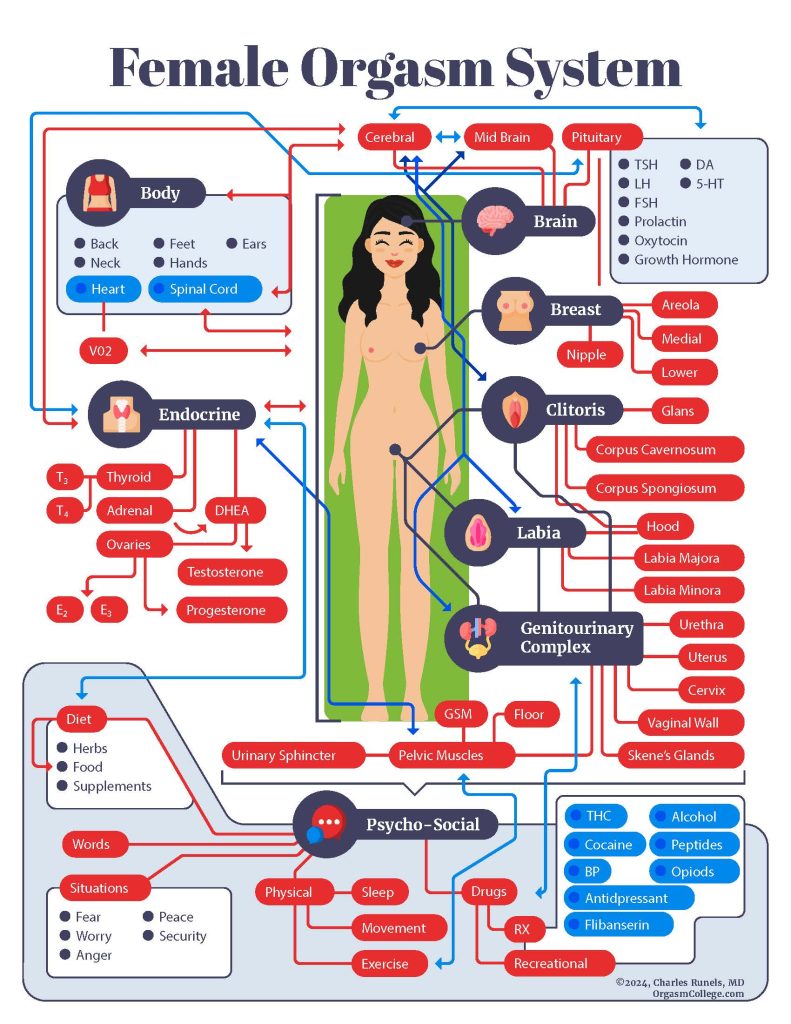
And this is where the newbies in our group, I think, become discouraged. So I want to talk about where to inject for anorgasmia. This is a sketch of just… sketched out all the things that need to be put in place to have an orgasm. Now, if you got lichen sclerosis, there’s the problem. You can look at it. It’s tissue. And so, remember PRP, I mean, you know it, but just I think it helps to remind ourselves we don’t have a magic shot. We can inject tissue and hope to make the tissue, nothing works all the time, but we can hope to make the tissue we inject to become healthier. And therefore, if that tissue is the etiology of the disease, the disease process becomes improved. Now with anorgasmia, it ain’t that simple. So take away one thing, like take away hormones.
You can still have a beautiful, healthy labia. You’re probably not going to have orgasm. Give her a social problem, make her a refugee in Ukraine or make her be so broke she can’t buy groceries or her husband’s beating her up. She might have trouble having an orgasm. So the point I’m making with this little sketch is that this is a system thing. It’d be like saying, “Well, I can’t breathe.” Well, your shortness of breath could be anything from cyanide poisoning, with your hemoglobin blocked, till you have a foreign body in your trachea, till you have asthma. You get it. Or profound anemia, because breathing involves a whole system. And I keep hoping we’ll hear more and more people using systems analysis when it comes to orgasm. If you get to think about systems when you have a bowel movement or take a breath, you should be able, I think, to think about systems analysis orgasm.
So if you just inject the vagina or the anterior vaginal wall or the clitoris with an O-Shot®, and the problem is one of these other things, and she’s got a central nervous problem, or she’s got something wrong with her spinal cord, you’re not going to help her. More likely it’s hormones or social, if it’s not, in our usual patients, or general health, it could be anything. So for that reason, I’d be careful. Anorgasmia is one of our least successful things. But when it works, it’s the bomb because sometimes anorgasmia is because there’s trauma from a mid-urethral sling or a bicycle or something. So look for the… Or just diabetes. Look for that and think about it when you’re treating anorgasmia. We do have research backing it up. And now, arousal. Again, this one’s tricky.
And so I want to point out, because those of you have been doing it a while, you know if your next five patients are people who can’t have an orgasm and all you do is give them an O-Shot®, maybe you won’t have such a good results. Where, if your next five patients have stress incontinence, there’s a very good chance you’re going to get a very good result without thinking about any of these other circles. You should, but you are still going to have a high success rate. Now with arousal, you have something similar in that it’s not that simple, because it could be so many things, and it’s not even what’s going on at the present moment. It could be so many things that happened last week or a decade ago. But this is, instead of having the usual… You guys know the sketch. So with men, we’re pretty simple. You got arousal, plateau, orgasm, and then you got a refractory period. All right?
And this space could be a few seconds to a few weeks, depending on the health of the person, age, et cetera. This is not the way women work. All right? The way women work, and this is not me talking, this is the research talking, but anybody that’s grown will know this to be true. So, if a woman has a negative experience… Men are pretty… They operate by this most of the time. Women are more elegant, more complicated, whatever words you want to use. We’re different. I like to remind people when they doubt that, that most men would be impotent with a testosterone level of 200, and most women are off the charts with their sex drive with a testosterone level of 150. So we’re the same, but we’re different. Okay. So negative feedback. A woman has an experience that’s negative, whatever, she’s with her lover, her husband, something goes a little wrong or maybe a lot wrong.
Let’s say she has pain. Well, the next time she’s wondering if that pain’s going to happen, so it is more difficult for her to be aroused. Maybe she has pain again, so she gets a negative spiral down. And even if something happened and the pain was magically gone, she’s going to have trouble getting aroused, because she’s going to be wondering about it. But now, let’s say that she’s down in this lower end and you give her an O-Shot® in her pain from dryness from having breast cancer, or her tearing pain from her episiotomy, not so bad. So the next time, she’s a little bit less tentative and more easily aroused. And so there’s a positive feedback loop. And maybe you throw in some testosterone and her orgasm is more powerful.
And so, it becomes so positive, and up here at the top, maybe it can be everything from just… Yeah well, I’m not going to go what this looks like, but this is usually pretty good. This breaks up families. You know, I have a little scuff on my car right now, and it’s just car, and I have a little ding in my windshield from where a rock came off from a truck. It’s just a freaking windshield, but it bugs me. And having sexual problems, even if you’re not thinking about them, I think bugs people more than they even want to admit. And so of course, we do our little shit there with the O-Shot® too, as you guys know, which I think can make this better and contribute it with a thousand other things from where the moon is to where the flowers are blooming, to somehow magically make this thing happen that is a truly love connecting experience.
[Rainer Maria Rilke 00:30:19] said two people loving each other is the hardest thing anybody body ever does. And if you just look at my little cartoon diagram of that, and that’s not even the psychological part of it, I think it’s not even hard, is an understatement. It’s more of a miracle. So I’ve, I don’t know how much longer before it’s the standard of care, but I think it’s coming. I just wanted you guys, where it was fresh on my mind. I didn’t want the people… Many of you were at the International Society of Cosmetogynaecology in Fort Lauderdale, but many of you were not. And I don’t want people that are not in our group to have things available that you don’t have. So I put the PowerPoint with all the links, as I said there, so you can read all that research if you want.
There are still people that wonder about the FDA. This was for their benefit. You guys know better. FDA doesn’t regulate PRP. Now, the other question that came up, I’m close to being done, but a question came up about occlusion. Someone who’s not in our group, worrying about… Let me see if we have questions before I do this. Oh we do. We got some questions. Okay. Okay. So Keith. Keith wants to know, “Is it better to try to fenestrate the plaque when someone that has Peyronie’s disease, or not? And where does shockwave therapy come in?” Nobody studied the injection technique. It’s a good question, as you know, and is apropos because we just talked about injection techniques with the O-Shot®. I know Richard Gaines who came up with the GAINSWave, he likes aerating the plaque.
Most of the time, actually every time I’ve ever treated someone with Peyronie’s, they can palpate it and they’ll put their finger on it and show it to you. I know Dr. [Beidas 00:32:34] is going to… Actually, two different doctors have offered to teach us to do an ultrasound course, and now there’s a little $2,000 handheld ultrasound. But you can feel it. And if you got ultrasound, use it. I’m not so sure it’s necessary. But anyway, the point is that’s some are doing as you suggested. On the other hand, Dr. Hunter, who’s probably done more P-Shots® than anybody else on the planet; seriously, he’s done so many P-Shots®; he says they get well in his clinic with just a regular P-Shot®, but you need to put him on the pump. And of course, you have research now showing that shockwave heals Peyronie’s too.
You can do them the same day, but my suspicion is that because trauma tears the small peptide change, you can’t even shake growth hormone when you mix it in the vial, that I would do always with PRP, make it the last thing. So do your shock wave, then do your PRP. Can be the same visit, but do the shockwave first, so you don’t break the [inaudible 00:33:46] and the amino… small peptide chains up. Let’s see. Patrick says, “[inaudible 00:33:55].” If you don’t mind, I’m going to… Dr. [Yam 00:34:02], I’m going to unmute you because you got something to contribute. Not a question, just a thing to tell us. Hold on, let’s see. If you want, it may be loud where you are, but I’ve unmuted you, Patrick, if you… Are you there? Okay, well, if you can get your microphone, I’ll just read what you wrote. If you can get your mic working, then jump on.
Says, “For androgenic alopecia, more frequent treatments seem to be better. New meta-analysis came out this month. The first meta-analysis shows a statistically significant correlation between the number of PRP treatments per month and the percentage change inheritance.” Wow, I missed that one. Oh, you gave me the link. Thank you very much. I’ll throw that in the thing right now. Let’s see. See, this is why I know stuff. I don’t know anything, but I’m a good secretary. No, that’s not it. Maybe I copied it wrong. I’ll tell you what, I’ll put it in the… I’m not sure why it didn’t copy-paste right, but I’ll put it in the email that goes out. I would like to see that study. Let’s see what other questions. Oh, he’s on the call. The champion. More P-Shots® than anybody on the planet. Dr. Hunter [Hansen 00:35:45]. Thank you for offering to jump in. Hold on. I’m going to unmute you.
P-Shot® Tips from Hunter Hansen
Dr. Hunter Hansen:
Hello.
Dr. Runels:
Hunter.
Dr. Hunter Hansen:
Hi.
Dr. Runels:
How’s it going? I swear nobody has done as many P-Shots® in the whole wide world. And I’m looking, trying to find somebody, so thanks for jumping in. So can you just enlighten us a little bit about what things might have changed? Enlighten us about what you’re seeing with Peyronie’s.
Dr. Hunter Hansen:
I do quite a few Peyronie’s patients, and you really summed it up as you were discussing that. Years ago, and I think I’ve been doing this for nine years now. Years ago when I started, I did a double treatment with PRP, one vial, just doing a regular PRP P-Shot® treatment, and then I made a whole nother injection into the plaque itself. And then I tried it without doing it that way, and I found that when you’re putting nine ccs of PRP in the penis, you’re really filling up the penis with PRP.
Dr. Hunter Hansen:
So the whole penis is getting activated and stimulated to regrow, so you don’t have to be specific for the plaque. You can just do a regular P-Shot®. So now I’m telling patients that if they have a concern with Peyronie’s, then I’m going to suggest they do three P-Shots®. But I do them four months apart because I want each one to be completely done before I do another one. So I space them out farther than other people, but we still do them in the package like that.
Dr. Runels:
[Crosstalk 00:37:27]. Go ahead [crosstalk 00:37:27].
Dr. Hunter Hansen:
And as you know, I make people get an erection in the office prior to doing a P-Shot®, because I measure people for length and girth prior to the P-Shot®. And then I remeasure them two months after they have a P-Shot®. When it comes to Peyronie’s patients, we take photographs of their penis before and after, so now that you can see a change in the curve.
Dr. Runels:
Just so everybody knows, so you’re also prescribing Trimix. And by the way, I don’t know if you’ve offered a formal class or not, but hunter is… Just talking with him, I think he… If Trimix were the same as being a chef, you’d be a Michelin star chef of Trimix.
Dr. Hunter Hansen:
Thank you.
Dr. Runels:
Have you decided to do a class yet, or are you [crosstalk 00:38:21]-
Dr. Hunter Hansen:
We’ve worked on some ideas of some people coming in who want to somewhat kind of franchise what I’m doing, but not just a general class to people. But I thought, sometime you and I were going to talk about that, and we still can.
Dr. Runels:
Yes. Thank you, because now that COVID is gone and the world’s getting back to normal, it’s time to revisit that, so I’m glad you’ve been patient with me. [Crosstalk 00:38:50]. Yes. I don’t even want to say, because I’m not even sure people would believe me. You guys take my word for it, this is a very smart man, very astute clinician, and you’re going to hear more from him, I think both with research and protocols. So anything else you would add as far as what we covered tonight, in concerning just how you’re thinking about where you’re doing the injection and also the shockwave? Are you doing shockwave and how are you integrating that?
Dr. Hunter Hansen:
We have a machine. We’ve had one for many years. I haven’t tried to promote it as much as the staff members have with patients. And my problem is you. You’re the whole reason, Dr. Runels, I’m going to tease you about it. But I’ve learned about the P-Shot® long before shockwave, and the P-Shot® has done so well, that it’s hard for me to recommend shockwave, which has to be repeated, and it’s available in chiropractor’s offices and spas and things like that. Whereas the P-Shot® in general is usually a one time or two time treatment for patients.
Dr. Hunter Hansen:
But yes, of course, and I do a lot, like you mentioned. I do about 600 P-Shots® a year now. So I’m doing a couple a day [inaudible 00:40:22]. And what’s so interesting, what’s funny, is that I have a lot of patients who want me to actually make this a comedy routine, because I’m so mean to them. When I go in the room, when I’m about ready to do it, I say, “We’re going to begin just as soon as I watch the YouTube on how to do this.” And then of course I numb them with lidocaine, I said, “If the lidocaine doesn’t work, I have a hammer.” And then I do the procedure, I tell them, “The rest of day, you can’t drink any water because it’s going to come out of all the holes.”
Dr. Runels:
Yeah. You definitely need to work up a P-Shot® routine.
Dr. Hunter Hansen:
Yeah. You don’t know me, how vicious I am to patients. Today, a man came in with a history of using an SSRI for anxiety, and I just answered, and I said, “Well, I just took away all the mirrors in the house.” That made him laugh actually, so it wasn’t so bad, he wasn’t insulted. But just a different way of looking at the world [inaudible 00:41:34].
Dr. Runels:
Yeah. Well, you’re always the beautiful combination of Southern gentlemen and also a scholar, so-
Dr. Hunter Hansen:
Oh, thank you.
Dr. Runels:
… I look forward to hearing more. But you’re the perfect person for the question. So the question that came up, that I was just about to go to, and then we’ll shut this down. And I understand the fear. It’s a reasonable question, because it’s the same one I worried about 11 years ago when I did the first P-Shot® on my own penis. And the query was, well, and this came from not one of our people talking to one of our people. And so the question was, “Well, what happens if you cause an occlusion in the penis, because that has happened with PRP?” And I have several things that I want to hear your thoughts on it, Hunter, but one thing is… Actually, I might have this pulled up. Let’s see if I do.
Dr. Runels:
Yeah. One thing is PRP is being used to treat occlusions. Like here’s one using PRP in combination with shockwave. No, that’s not it. PRP for… Yeah, for embolic necrosis from hyaluronic acid. But the bottom line is you can go through and find where PRP’s being used, because there’s no blood flow. All right? So there’s that argument. My worry though, when the first time was, I thought, “Okay,” when it forms that matrix, maybe it will cause, not occlusion, although that was a worry, maybe I get necrosis of my penis. I was more worried about priapism. Maybe I’ll just get an erection, I got to go do the 18 gauge needle thing, but it didn’t. And now we have the other argument that we’re safe, is that now we have many… I would guess that we’re were probably pushing somewhere between 300 and a half a million P-Shots® by now, and it hasn’t happened.
Dr. Runels:
The other thing is that I looked… I’ve gone all through the literature, trying to find where someone had an occlusion with necrosis, and the only necrosis I’ve been able to find; and miss something, I want to know about it; but the only necrosis I found from PRP was one in the face, where someone had also used an unknown filler and it was done in a hotel room somewhere. Nobody even knew what the filler was. And the person got some necrosis in the face. But the title of the article insinuated that PRP was to blame, and you had to read the… It’s like reading the New York Times. You had to read the middle part to find out the whole story. So, that’s my rambling, but tell me what your thinking is about the worry of some sort of necrosis.
Dr. Hunter Hansen:
First of all, it may be a reflection of my technique, because as you know, for all these years, I’ve been using a Magellan machine to obtain the PRP, and the Magellan people have told me over and over again that I don’t need to use calcium to activate my PRP, so I never have. I’ve never added calcium in, so I’m never trying to form that matrix at all. So there’s nothing that’s really… There’s no fibrin that I’m generating when I’m doing the PRP. And what I tell patients, I’m basically bathing the whole inside of the penis with the growth factors and they’re going to flush out fairly quickly, but I’m not worried about that because all I have to do is touch the different cells in the penis with the PRP solution. And I think it works like a weed killer. I think then just touching themselves will stimulate them to say, “Hey, we have to start regenerating ourselves.”
Dr. Runels:
Interesting.
Dr. Hunter Hansen:
So I’m not worried about it sticking, so to speak. I think the idea of it sticking in the anterior vagina has a lot more argument than the penis part. And I’ve got an OBGYN doctor that works in my practice, that does the O-Shots® now. I don’t do O-Shots® because he takes care of that division, but I don’t use anything in the penis and I’ve never had a problem. And years ago, then I even treated a man with a testicular mass that he had for 10 years, that was highly evaluated and no one ever found there was anything wrong, and I injected that with PRP and it disappeared. So I think it helps dissolve things more than creates any problems.
Dr. Runels:
Interesting. You know, the other thing to think about is that I know [Regen 00:46:40] alone sells more than a million kits per year. I don’t know how many and absolute numbers are sold by the other manufacturers, but you have Magellan and PureSpin, and have all these different kits going out, and I’m not seeing any necrosis in the literature. So versus one in 11 who get a mid-urethral sling, versus have decreased sexual function, or 35,000 people per year dying from GI bleeds from non-steroidals. So I still stand by my idea that there’s nothing safer than a PRP injection when it comes to medical procedures. The other thing I think comes back to our group, in that if something does try to be, if something is blamed, like we had… The only thing I know of that ever went to court, was somebody trying to blame an infection on their P-Shot®.
Dr. Runels:
And the infection was weeks after the P-Shot® was done, wasn’t in the penis at all, but it still went to court. And we had someone from our group who testified, “Yeah, this is what we do. And no way this could have caused this.” And it settled in a few moments in favor of our person. The point being that there is some safety in numbers, and not just in numbers, but at least having some guidelines about how we’re agreeing to do things; to use a kit that’s FDA approved, to follow certain techniques, so that we can learn from each other. We’re hoping to start another study now. I don’t want to jinx it by talking, but within the next week, hopefully, I’ll announce another study we’re doing. So we’re still doing. And Judson Brandeis is close to finishing and publishing the study he’s been doing on the P-Shot®.
Dr. Runels:
So there’s some safety, and not just learning, but safety in numbers. And then, not just within our group, but just the numbers of people injecting PRP. So back to the question, I think 10 years ago, it was a more worrisome thing than now with hundreds of thousands of P-Shots® all over the world, lots of research, and nobody’s had a necrosis ever. So I don’t know anything else; if you were going to talk to somebody just starting off, Hunter, about maybe what one tip what not to do, and one tip what to do, as they get started with their PRP course?
Dr. Hunter Hansen:
Sure. And I’ll probably describe using the vacuum pump different than you do, so I’ll just [crosstalk 00:49:42] how I talk about it.
Dr. Runels:
Yes. Yeah. Do that too.
Dr. Hunter Hansen:
Okay, so I tell patients too, that no one ever gets hurt with what I do with the P-Shot®, with the PRP procedure. However, I’ve had patients who’ve hurt themselves after, by being too zealous with the pump. [Crosstalk 00:50:00] foreskin, or have done other local trauma because men are men, they think more is better. And what I try to stress with the patients is that the point that I see of using a pump is to keep blood flowing through brand new blood vessels. So I describe that every time we get a cut on our body, our body forms tiny blood vessels that feed the cut, and when the cut heals over, our body reabsorbs those blood vessels. And if it wouldn’t be so, we would look like a Dalmatian. We’d have all these splotches of red everywhere we’ve been cut.
Dr. Hunter Hansen:
So it’s a good thing that we get rid of blood vessels when we don’t need them. And so then I tell patients, “What I’m going to do is create a lot of new blood vessels in your penis. If you don’t use them, they’re going to go away. So the pumping is to pull blood through the penis a couple times a day.” I’m not trying to make them stretch the penis. I’m just trying to keep circulation going. And what I’m trying to do is keep people from over pumping, because that’s where people have been hurt. I think, if 10 minutes is good, 20 minutes is better. And I go, “No, no, no. Back up, back up.” We’re just trying to keep that circulation intact. So I’m trying to just get rid of that side effect of people worrying about the pumping so much.
Dr. Runels:
And did you see, [crosstalk 00:51:23] I don’t know if you were here last week, but we had actually showed a picture where someone pumped so vigorously, they got a phimosis because the foreskin swelled up and it was so swollen that the glands couldn’t retract and he had to go to the ER to get it reduced. And there was no bad outcome, but I’m saying that’s… And the same thing, if someone tells me their erections are decreased after a P-Shot®, I always tell them, “Just stop the pump for a week because you’re probably overdoing it.” And then things get to be wonderful. Keep going. I’m sorry. I’m just saying that I’m agreeing with you.
Dr. Hunter Hansen:
[Crosstalk 00:52:04]. And then I numb people real well, which I joke about, but I put lidocaine cream on, and I do five 1cc injections of lidocaine at each of the locations that I’ll eventually put the PRP. And then wait for [crosstalk 00:52:24]-
Dr. Runels:
You do a little wheel with the 31 gauge or something?
Dr. Hunter Hansen:
Yes. Well, it’s a, I think, maybe 27 or so. It’s the same like insulin syringe, is what we’re using with an auto injector.
Dr. Runels:
Okay.
Dr. Hunter Hansen:
And then, I wait for about five minutes, then I do the procedure. So I let the medicine take. And I would say 80% of my patients never know I’m doing anything because they’re completely numb.
Dr. Runels:
You took it to a different level. That’s wonderful, Hunter.
Dr. Hunter Hansen:
And then on the other side, there are people who are just so scared that everything hurts. And there’s a warning. If someone really doesn’t like their blood draw, if it really hurts them, there’s a good chance though, no matter what you do, you’re still going to hurt them, because they’re that psyched up about a needle going into them anywhere.
Dr. Runels:
Yeah. So what do you do with those people?
Dr. Hunter Hansen:
I just keep going, even though I know that that is an issue. Again, I have lidocaine cream on the outside and we put a very, I’m going to say it’s over 20% lidocaine, but I let it sit on someone for half an hour. So they’re pretty numb even before I do anything else.
Dr. Runels:
Gotcha. Okay. [Crosstalk 00:53:45].
Dr. Hunter Hansen:
And I joke with them. I say, “Be careful the rest of the day, because you won’t know where your penis is.”
Dr. Runels:
Be careful with that zipper, right?
Dr. Hunter Hansen:
Yes. You may have to sit down and go to the bathroom, it’s just not going to be there. But my joking really helps calm people because they’re very scared about what I’m going to do.
Dr. Runels:
Yeah. It just doesn’t seem right to say the word needle and penis in the same sentence does it?
Dr. Hunter Hansen:
No. Right.
Dr. Runels:
What tips do you have about, so if someone was just starting, what would you… Those are great pearls by the way, as far as the numbing. What other pearls would you have as far as what not to do?
Dr. Hunter Hansen:
Well, I don’t want to oversell the P-Shot®. I don’t think… People want to pin people down to how much growth if I’m going to get. And I say it’s not always about growth. And I explain some people get longer, some people get bigger around, some people do both. I’m putting fertilizer in the penis. Your penis is doing the growing, not me.
Dr. Runels:
Gotcha. That’s a good way to put it.
Dr. Hunter Hansen:
And I’ve had over 20 men that have done P-Shot® six times. What I have found with those people, is that the results are very different each time. It’s not progressively better or progressively worse, it bounces around. And since I’m doing the same procedure with the same machine, I’ve used the same machine for the last 10 years, then it has to be how healthy they are and how good their blood is. So at one point they’re not as good as other times. I’m not generating maybe as many growth factors this time around as I did another time. That’s why I also tell patients that, and that I can’t promise a certain response to a certain P-Shot®.
Dr. Runels:
That’s a good way… All great tips.
Dr. Hunter Hansen:
And I don’t lead with a P-Shot®. I’ve heard of some clinics that try to get everybody to have a P-Shot® first, before they do other treatments for erections. I discuss it with all my patients. We really don’t do external marketing because people are coming to see me for erection problems. Most of them because pills failed them. And so yes, I’m the man that mixes a custom blended Trimix for each person to make it work. So that’s what I’m getting known for. And then with that, then I’ll discuss the possibility of doing a P-Shot®, and I describe how it helps generate new tissue and helps erections and helps general health. And that’s [crosstalk 00:56:46].
Dr. Runels:
Let me catch up with you just a second. So you said that you’re not advertising?
Dr. Hunter Hansen:
Correct. Yeah. We don’t do outside advertising for the P-Shot®.
Dr. Runels:
Yeah. So you guys, I want to make sure. I was having you say that so everybody heard, because I think people have this feeling that they have to, if they’re not doing some dance on TikTok or something, that they can’t grow their practice. I guess there’s a place for that, if that’s your personality, but primarily you’re marketing to your people and they keep coming back and telling their people, at least when it comes to the P-Shot®.
Dr. Hunter Hansen:
Correct.
Dr. Runels:
All right. You know, we have… By the way, I just put, because you were talking about the variables. Jeff Piccirillo did this. I didn’t do anything. I just wrote the foreword, but Jeff used his expertise as an orthopedist and a sales rep with PRP to put together an extensive explanation about all those variables you were talking about, so it’s worth having this around the office. But we are all different from day to day, just not different people, but the same person from day to day. So I’ve seen some of those same ideas where people come in, and sometimes even with the O-Shot® as well, sometimes they get different results, the same person.
Dr. Hunter Hansen:
Mm-hmm (affirmative). And some fail as you know, because they’re taking NSAIDs, because that would counteract what we’re doing. Some fail because they choose not to use a pump. But actually, what I’ll tell people, is that they may get results much later on, because I’ve had people who actually improved maybe six months later. It just didn’t work quickly for them.
Dr. Runels:
That reminds me. I had the same thing happened with a woman who came to see me for an O-Shot® for anorgasmia, just flat up, “Can’t have an orgasm, no matter what I do.” I gave her the O-Shot®. It was three months out, she still didn’t have an orgasm. She was kind enough, she didn’t want her money back, so I worked it off by… I said, “Well, let me… every time you get Botox, get it for free.” And then probably, I don’t know, it was about three to six months later, I asked her if she wanted to use my Emsella machine, because I got one in. She said, “Oh I don’t need that. I’ve started having orgasms.” So she never let me know, but she was having these crazy mind blowing orgasms, but as you said, it didn’t kick in until six or nine months after the shot.
Dr. Hunter Hansen:
Right. So all is not lost.
Dr. Runels:
Here’s the thing. I know I could talk… It’s nine o’clock, so I’m going to end it, but I know that I could talk to you literally for days about your erection clinic there. It always helps my soul, because you came to my little class in Atlanta and I gave you A-B-C, and you made the whole freaking dictionary out of it. So I love how you’ve taken my little ideas and turned them into something beautiful. Yeah, we need to get together, Hunter. And I appreciate you jumping on. I think with that, guys, we’ll call it. You guys have a good night. Thank you for helping us out, Hunter. Bye-bye.
Dr. Hunter Hansen:
Thank you.
Relevant Research
Berebichez-Fridman, Roberto, and Pablo R. Montero-Olvera. “Sources and Clinical Applications of Mesenchymal Stem Cells: State-of-the-Art Review.” Sultan Qaboos University Medical Journal [SQUMJ] 18, no. 3 (December 19, 2018): e264-277. https://doi.org/10.18295/squmj.2018.18.03.002.
PowerPoint Slides Shown with active links to the research<–
Relevant Links
–>Next class to learn to inject the major joints (knees, elbows, shoulders, Achilles) with PRP<–
–>Apply for Further Online Training for O-Shot®, P-Shot®, Vampire Facelift®, Vampire Breast Lift®, Vampire Wing Lift®, or Vampire Facial®<–
–>Next Hands-on Workshops with Live Models, worldwide <–
–> IMPORTANT (ONLY) IF YOU ARE NEW TO THE CMA: Please take any relevant online tests so that we can immediately list you (and your clinic) on the directories and start supplying you with other helpful marketing and educational materials. Testing takes an hour at most (including watching the videos. If you want to expedite the testing, you can simply call the CMA headquarters (1-888-920-5311 9-5 New York time Mon-Thur; 9-12 Fri) and one of our business consultants will log you in and walk you through where to find the study materials and the tests. If you are already on the directories for the procedure(s) you provide, then you already took the tests or did hand-on training with evaluation by your instructor.

Cellular Medicine Association
1-888-920-5311




Leave a Reply